One of the key functions that KCRHA holds in our community is to oversee Coordinated Entry (CE). This is the process we use to equitably distribute the limited housing resources we have in our homelessness response system. When an individual or family connects to CE, their needs will be assessed, their preferences evaluated, and they will enter the pool of households waiting to be placed into the best housing resource for their current situation.
An individual or family can access CE at a Regional Access Point (RAP) or at a variety of participating service provider locations such as shelters, day centers, or by connecting with an outreach team. At these locations, people seeking housing can be enrolled in CE, which begins the process of connecting them to a housing resource, such as rapid re-housing, transitional housing, permanent supportive housing, or permanent housing.
Because the demand for housing resources in King County currently outweighs the supply, CE cannot guarantee placement into a resource, but accessing CE can be an important first step to finding housing.
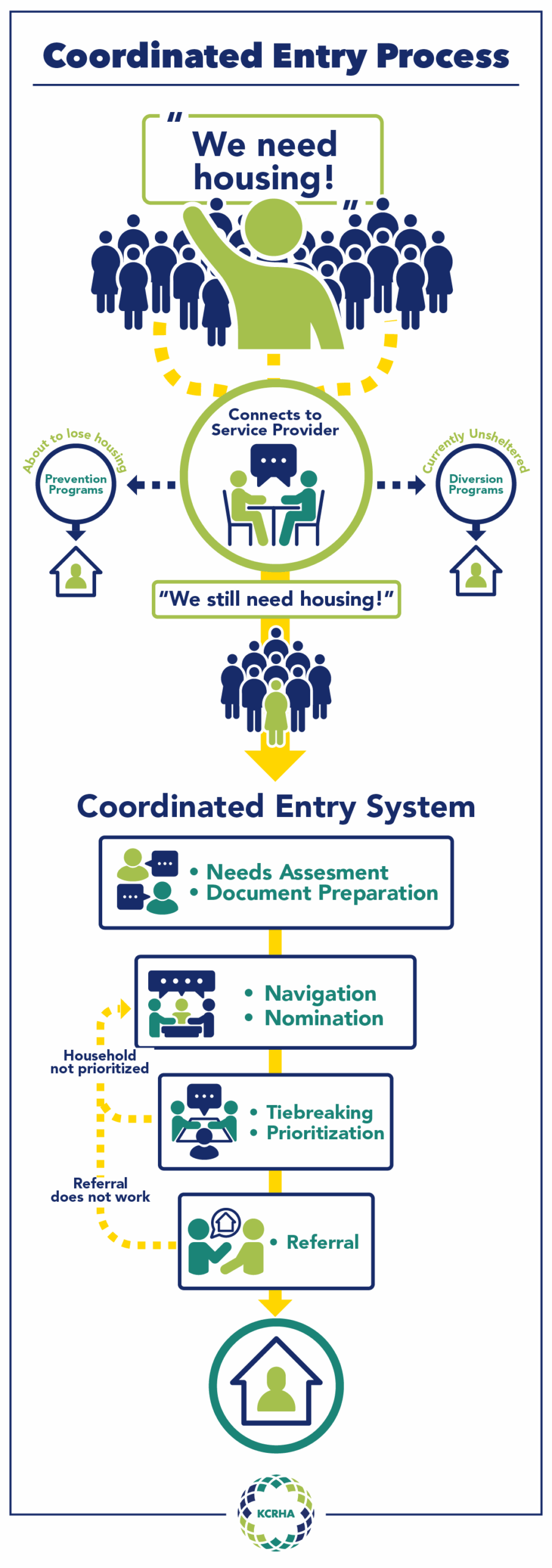
When a household (how we refer to either an individual or a family seeking a single housing resource) first connects to CE, they complete a basic Homeless Management Information System (HMIS) enrollment and basic CE enrollment. We want to collect the minimal amount of information to achieve the best result for the household, maintaining privacy and autonomy while maximizing effective placements.
These tools have a specific role in information gathering:
- HMIS enrollment gathers basic identifying information
- CE Enrollment gathers U.S. Department of Housing and Urban Development (HUD)-mandated information: history of homelessness, disability information, income, housing preferences, needs, and barriers
Together, the information gathered across those tools allows CE Assessors to have a good picture of what sort of housing resource may work best for that household.
Once a household is completely enrolled, the waiting period begins while the needs of everyone who is enrolled but not yet placed are evaluated, and households are prioritized for a specific resource. CE Assessors participate in daily and weekly sub-population case conferencing to determine which household has the greatest need and is the best fit for the presently available resources. In short, CE is triaging the very full “waiting room” of currently unhoused individuals and families waiting for safe, stable housing.
The factors that influence whether a household is prioritized or not include:
- The length of time that has passed in their current episode of homelessness
- If they’re fleeing or attempting to flee a domestic violence, intimate partner violence, or trafficking situation
- If they are currently living unsheltered
If they’re not prioritized, they stay in the pool until they are—or until they find housing by other means.
If they are prioritized, they’re referred to a housing resource that seems like a good fit for their needs and preferences.
Not all referrals are successful immediately, or in the long term. A household may turn down a resource if they decide it isn’t a good fit before moving. In the case of unsuccessful referrals, that household would return to the pool waiting to be prioritized for a different resource.
Matching a household to the right resource can be complicated, but we are seeing signs that the performance of CE is improving. For example, in 2023, 48% of the households that were referred to housing resources successfully enrolled in the resource to which they were referred, whereas in 2024, 55% of the households referred were successfully enrolled—a 7% increase.
At the end of the day, the goal of Coordinated Entry is to ensure that everyone who needs housing has equitable access to the limited resources that are available by providing a unified access point for the whole community.
If you’d like to continue learning about Coordinated Entry, please visit our freshly updated Coordinated Entry page (oriented for service providers) or our For People Experiencing Homelessness page (oriented for people seeking services). We are also currently working on a new data dashboard for CE data and expect to have it out in the first quarter of this year.