
The 2026 Point-in-Time (PIT) Count began on Monday, January 26, and it will run through Friday, February 6. The PIT Count is a biennial survey of people living without shelter in our community, and a critical tool for understanding unsheltered homelessness in King County. This survey gives us important information about how many people are living unsheltered in our region, their demographics, networks, causes of homelessness, and more. The PIT Count is the single largest and most comprehensive look at unsheltered homelessness in King County, and will be used to inform policy, planning, resource allocation, and further research.
Prior to 2022, the PIT Count was done on a single night—sometimes referred to as a “one night count”—with volunteers going out to look for people living unsheltered and counting them. Although this method galvanized community engagement, it produced an undercount and wasn’t able to produce the level of detail needed to address the complexities of people’s experiences.
When KCRHA took over the administration of the PIT Count in 2022, we shifted to a different methodology: Respondent Driven Sampling (RDS). RDS has been endorsed by numerous studies by academic researchers, confirming its effectiveness in producing high-quality demographic and population estimates. Having completed PIT Counts in 2022 and 2024, this will be KCRHA’s third count using RDS.
How does Respondent Driven Sampling work?
RDS relies on peer-to-peer recruitment to reach the community and uses a coupon system to achieve that. KCRHA will distribute the initial round of coupons, known as “seeds” to selected organizations that do outreach to people experiencing homelessness. Outreach volunteers and staff will distribute the seed coupons to unsheltered community members in encampments around King County.
Once an individual or household has a voucher, they can go to one of many PIT Count Hub Sites, take a survey, receive a gift card for their time, and take three coupons to distribute within their networks.
This creates a referral chain, allowing us to reach deeper into the unsheltered community, leading to more accurate, robust, and representative data collection.
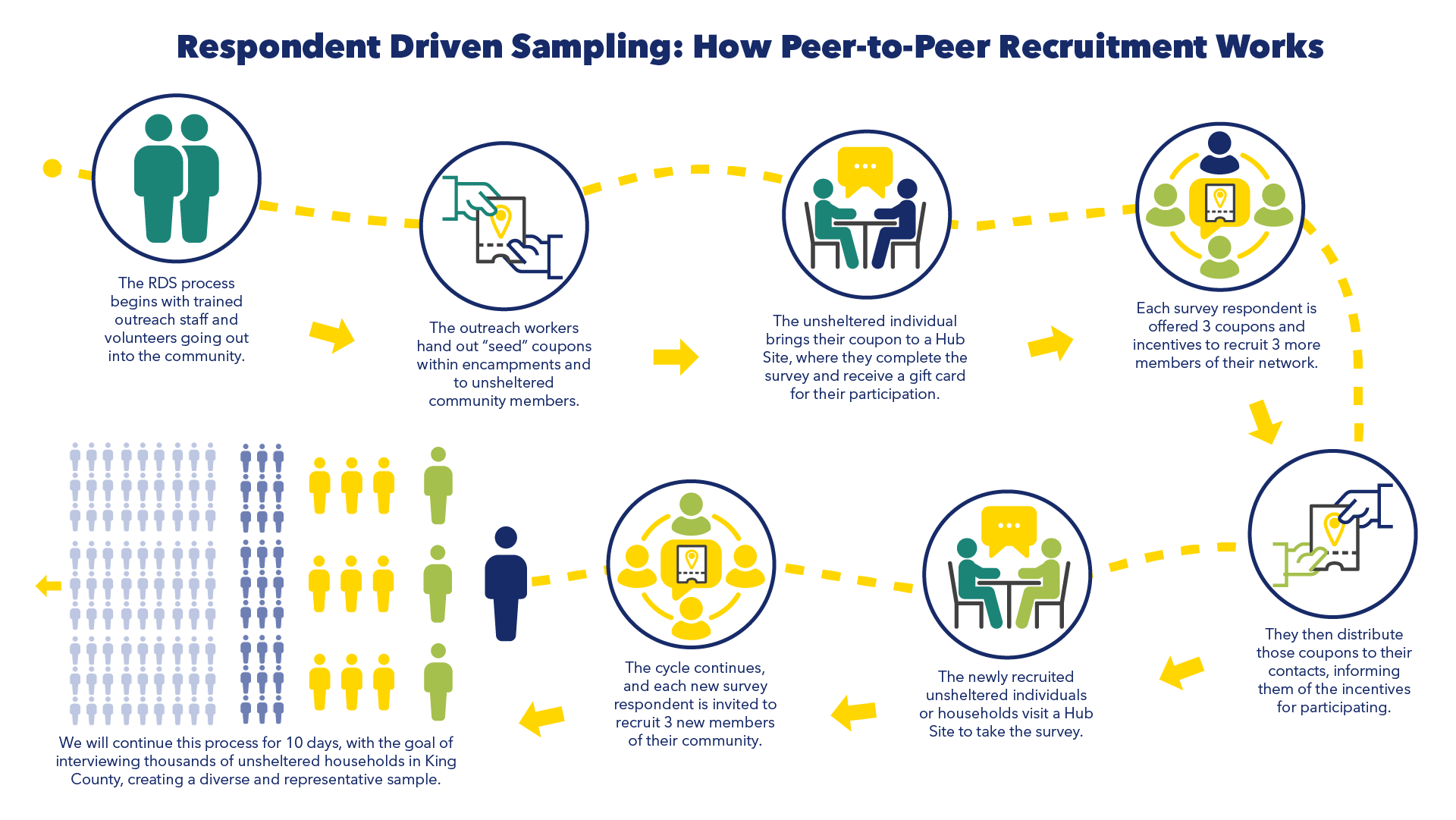
We will collect data from unsheltered neighbors for ten days at 25 different sites located throughout King County.
It is important to note that RDS is not a census, but a rigorous data sample that, when used in conjunction with data in the Homeless Management Information System (HMIS), allows us to derive high quality estimates. RDS is a humanizing research process—it invites individual connection and collection of data on lived experiences, while holding to the high standards of academic researchers.
Note: Since this is a research project aiming for a representative sample, and maintaining the integrity of the gathered data is critical, we do not accept “drop in” participants, and do not share the location of the data collection sites. To participate, one must receive a coupon from either a seeding volunteer/outreach worker, or a member of your network/community.
What did we learn from the 2024 PIT Count?
KCRHA has been administrating the PIT Count since 2022. As it is conducted every other year, this will be our third time administrating the count. We hope to improve the process each time. Here are some of the notable changes we’re making this year:
- We have expanded from 19 to 25 data collection sites located strategically throughout King County. This will allow us to get more detailed demographic information within our county’s subregions.
- Some of those 25 sites are mobile and will travel to rural and unincorporated areas to further increase coverage throughout the county.
- We continue to improve our survey platform, streamlining the survey process, and ultimately improving data quality.
- This year, we will be able to collect data from unaccompanied minors ages 13-17, improving the youth representation in our research.
When will we know the results?
This is a large research project, done in partnership with the University of Washington. After data collection is complete, the data will be analyzed and released over time. We anticipate the first release to be a shortened, high-level report, around mid-May of 2026. You can keep an eye on our Point-in-Time Count page and subscribe to our monthly newsletter to receive updates as they’re available.