The 2026 Point-in-Time (PIT) Count found that on any given night in King County, an estimated 18,365 individuals experienced homelessness. While many achieve housing and stability each year with the support of dozens of service providers across the region, there continues to be a net growth in this population because inflow into homelessness remains higher than the number of people exiting. The 2026 PIT Count reflects this reality: homelessness continues to rise because the need outpaces available resources.
Comparison of Overall Homelessness by Individuals, 2022, 2024, and 2026
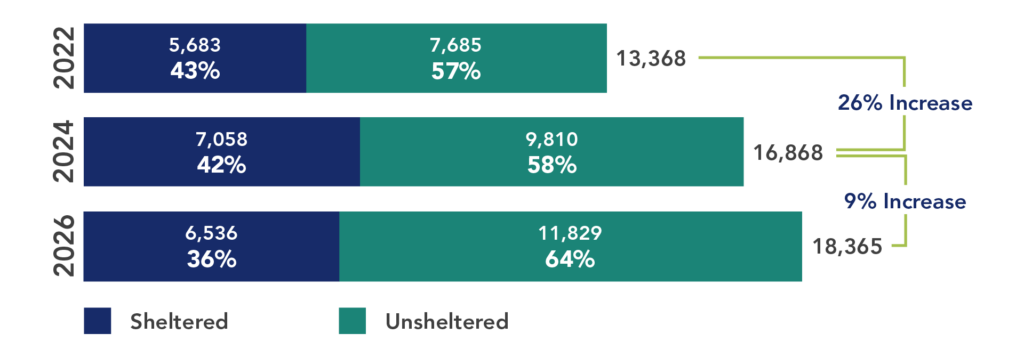
The sheltered count is 6,536 and unsheltered is 11,829. Sheltered homelessness refers to people who are staying in emergency shelters, transitional housing programs, or safe havens. When someone is experiencing unsheltered homelessness, their nighttime location is a public or private place not designated for sleeping such as a car, public park, abandoned building, bus or train station. The increase in the overall number from 2024 to 2026 slowed to 9 percent, suggesting some stabilization even as the overall need continues to rise. Comparatively, between 2022 and 2024, the overall number of people experiencing homelessness increased by 26 percent.
“The Point-in-Time Count captures any given night, but homelessness is addressed by a dynamic system. Every year, thousands of people exit homelessness into housing, while thousands more enter because housing remains out of reach for too many people in our community,” said KCRHA CEO Dr. Kelly Kinnison. “The challenge before us is not simply responding to homelessness but reducing the conditions that cause people to lose housing in the first place.”
Shelter availability declined slightly, driven in part by the loss of family shelter beds. Unsheltered family homelessness has increased since 2022 — from 1,253 individuals in 415 households to 2,224 individuals in 647 households in 2026. Homelessness also continues to disproportionately impact communities of color in King County.
Mary’s Place provides services to families experiencing homelessness through shelters, mobile outreach, and prevention. They hear from dozens of families with children a day.
“At Mary’s Place, the emergency family intake line rings 40 to 50 times every day from parents desperately searching for a safe place for their children to sleep. That is the true measure of need. The trauma of losing your home follows children into their classrooms, their relationships, and their futures,” said Dominique Alex, Mary’s Place CEO. “We need more shelter, but what we need most to end this crisis and provide opportunities for children to thrive is sustained investment in preventing homelessness before it happens.
While the PIT Count provides an important snapshot of homelessness, it captures only one moment within a much larger system. Over an entire year, the homelessness response system serves thousands of people who exit homelessness into housing through shelter, Diversion, Rapid Re-Housing, Permanent Supportive Housing, and other interventions.
“Homelessness is a very serious regional crisis, but don’t discount the facts: we are making real progress – and we’re incredibly proud of that,” said Karen Lee, CEO of Plymouth Housing. “In the study period, more than 10,000 people either moved into or remained in stable housing like Plymouth’s. This shows that if we keep investing in solutions that work, we can help thousands more find a home.”
The 2026 PIT Count highlights both the scale of the challenge and the importance of continued investment. Emergency shelter, outreach, and housing programs help thousands of people every year, but long-term progress will require expanding the affordable housing and supportive housing resources that prevent homelessness and create permanent pathways out of it.
Homelessness Contributing Factors
Research consistently shows that homelessness is closely linked to housing affordability and housing availability. Communities with high housing costs and limited affordable housing often experience significantly higher rates of homelessness, regardless of poverty rates alone. As University of Washington researcher Gregg Colburn has noted, Seattle has fewer people living in poverty than Detroit on a per-capita basis, yet significantly higher rates of homelessness. The difference is not poverty alone, but the cost and availability of housing.
In King County, continued population growth, rising housing costs, and an insufficient supply of deeply affordable housing have created conditions in which many households remain one crisis away from losing housing stability. According to the National Low Income Housing Coalition’s (NLIHC) Washington state housing profile, only 28 rental homes are affordable and available for every 100 extremely low-income households. Additionally, the NLIHC cites the Seattle/Bellevue metro as the most expensive area in the state.
The challenge is particularly acute for older adults, people living with disabilities, and individuals surviving on fixed incomes. For many residents relying on Supplemental Security Income (SSI), monthly benefits cover only a fraction of the cost of housing in the Seattle region. At the same time, demand for Permanent Supportive Housing — a proven intervention that combines affordable housing with supportive services — continues to far exceed available supply.
2026 Pit Count Comprehensive Report Release
Later this year, KCRHA will release a comprehensive 2026 PIT Count report. In it, community members can expect to see:
- More in-depth explanation of scope, sources, and methodology,
- Additional analysis of communities impacted by homelessness,
- Break out information on people experiencing homelessness in individual subregions of King County,
- Demographic results by racial/ethnic identities, gender identity, age, and household composition,
- Summary findings,
- And Appendices, including documents used during the Count.
Finally, a thank you to the thousands of people who participated in the 2026 PIT Count survey, and the volunteers, staff, and community partners who made this work possible. Their collaboration with KCRHA staff helps our region better understand homelessness and the support needed to move more people toward safety, stability, and housing.
Related Links: