
The purpose of Coordinated Entry (CE) is to ensure streamlined access points to Permanent Supportive Housing, Rapid Re-Housing, and Transitional Housing are available to people experiencing homelessness in King County. It is one of the first steps for people experiencing a housing crisis. Currently, there is not enough housing for people who qualify through Coordinated Entry to house everyone experiencing homelessness in King County. There is no guarantee that a household will be connected to a housing resource through Coordinated Entry, or if they are, meet the eligibility criteria for the housing resource. Coordinated Entry does not create new housing; it’s a system to connect people experiencing homelessness to limited specialized housing resources.
Click here to find Regional Access Points.
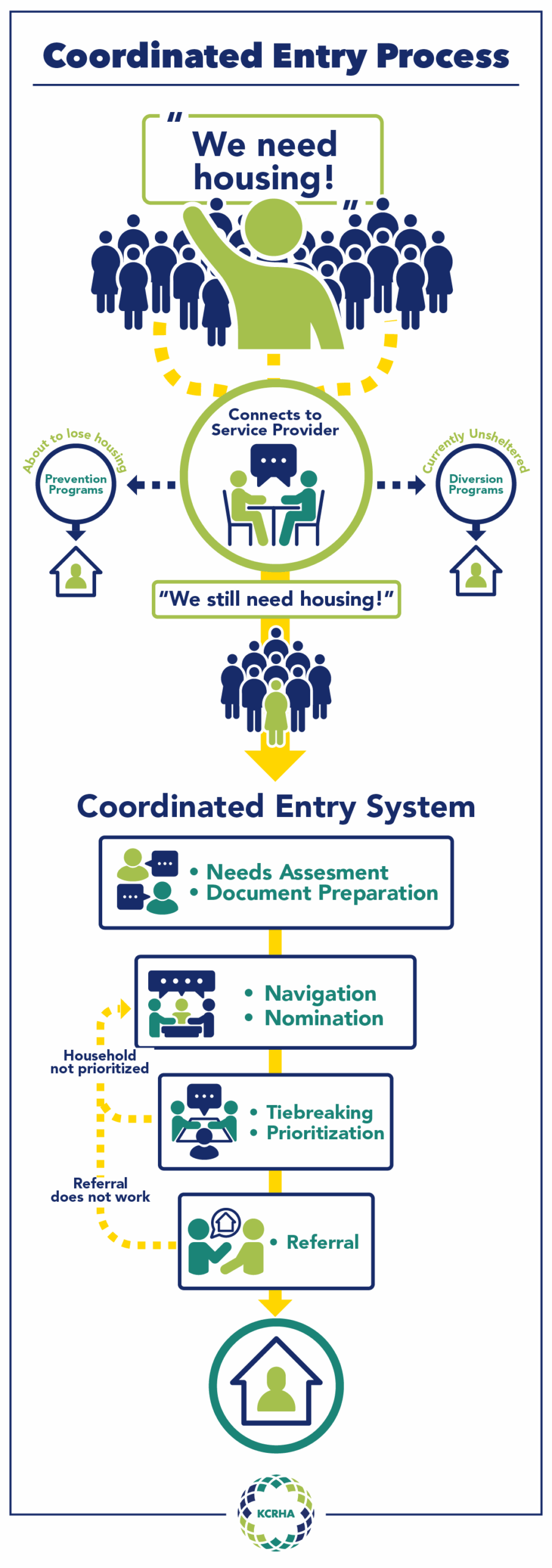
Coordinated Entry Assessors are how individuals and families who are experiencing homelessness access and navigate Coordinated Entry. CE Assessors are found at Regional Access Points, shelters, day centers, and on outreach teams. They serve people experiencing homelessness by enrolling them in Coordinated Entry and navigating them into housing.
Coordinated Entry uses a basic HMIS enrollment and a two-question Housing Triage Tool (HTT)* collecting only the minimal amount of information needed for service matching and prioritization.
- History of homelessness (HUD mandated)
- Disability information (HUD mandated)
- Income (HUD mandated)
- Household type
- Pregnancy in household
Coordinated Entry also collects information on housing preferences, needs, and barriers using the Housing Needs Form (HNF).
*As of March 2022, the Vulnerability Index-Service Prioritization Decision Assistance Tool or VI-SPDAT is no longer part of Coordinated Entry
Tiebreaking currently consists of five criteria that are applied in descending order as follows:
- Households with approved Mobility Requests
- Households who were prioritized as of 4/14/23
- Households with the longest length of time homeless in their current episode
- Households who are fleeing or attempting to flee violence
- Households who are unsheltered
Referrals are generated from Coordinated Entry case conferencing. Currently, CE case conferencing is fielded primarily through online, digital formats. CE Assessors can view available housing units through a Coordinated Entry online hub and submit nominations to these units for households who are prepared to complete housing application packets. Once a match is made to a unit through the CE tiebreaking process, CE team members facilitate the housing referral and connect the Assessor or housing navigator with the housing provider.
Housing providers who receive Coordinated Entry referrals are encouraged to attend weekly Office Hour meetings to inform, coordinate, and collaborate with the nominating providers and Coordinated Entry System staff.
Households can decline available housing resources based on preference or need without negative repercussions.
Coordinated Entry makes referrals for households experiencing homelessness to a variety of housing resources. These include Rapid Re-Housing, Transitional Housing, Permanent Housing, and Permanent Supportive Housing.
CE Assessors
CE Assessors are a key part of Coordinated Entry, and support people experiencing homelessness by:
- Serving as the initial contact point for Coordinated Entry and communicating Coordinated Entry eligibility
- Exploring resources such as Diversion or problem solving, employment, and education
- Enrolling households into the Coordinated Entry System Program and administering the HTT
- Communicating with households about next steps and availability of other resources
Steps on how to become a Coordinated Entry Assessor
Diversion offers flexible, light-touch services that may be coupled with minimal financial assistance that results in a temporary or permanent housing arrangement outside of the homeless system.
CE Housing Providers
Coordinated Entry promotes housing stability and recognizes that circumstances arise which may require a change in a current housing placement.
A Mobility Request is a process by which a provider can request their client be transferred from one CE participating housing resource to another. If a Mobility Request is approved, the household will be prioritized in the CE System to ensure their swift transfer to another housing resource.
- CE Mobility Request Form PDF & Word
- Intra Agency Transfer – Homelessness Waiver
CE Policy & Governance
Coordinated Entry Committee is part of the Continuum of Care structure
The Coordinated Entry Committee (CEC), as outlined in the King County Continuum of Care (CoC) Charter, oversees policies and procedures related to Coordinated Entry within King County. The committee identifies, reviews, and approves policies and procedures guiding the operation of the Coordinated Entry (CE).
Click here to find Regional Access Points or Frequently Asked Questions about Coordinated Entry.